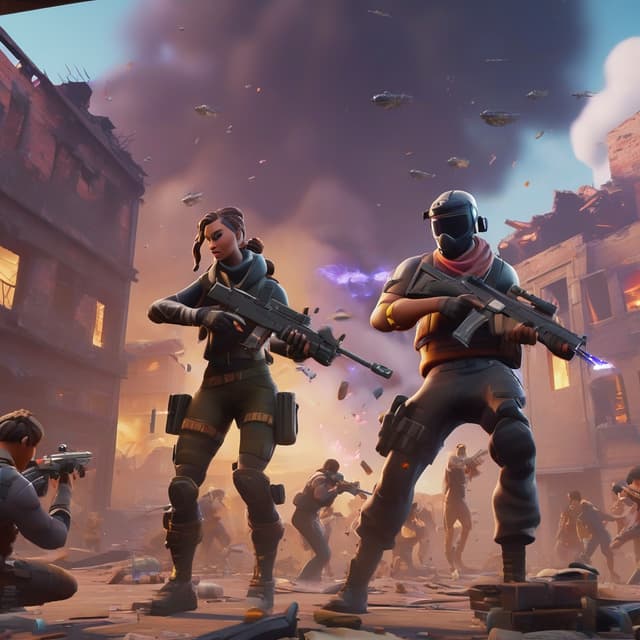
| Name | Fortnite War |
| Type | Global conflict |
| Cause | Competition for dwindling natural resources and technological supremacy |
| Legacy | Continues to reverberate through modern geopolitics and society |
| Impacts | Devastating environmental and humanitarian consequences |
| Tactics | Shifting alliances and intense 'battle royale' style battles |
| Combatants | Numerous factions and nation-states |
| Time period | Late 2010s - early 2020s |
The Fortnite War was a major global conflict that took place primarily between 2018 and 2023, drastically reshaping the political and economic landscape of the 21st century. Centered around competition for control of strategic natural resources and emerging military technologies, the war involved a shifting array of alliances and coalitions fighting for dominance in a battle royale-style struggle.
The seeds of the Fortnite War were sown in the late 2010s as rising powers like China, India, and Russia clashed with established Western hegemons over access to increasingly scarce oil, minerals, and rare earth elements. The global rush to secure these critical resources, which were essential for powering the burgeoning green energy and high-tech industries, led to a breakdown in diplomatic relations and growing militarization.
At the same time, advances in fields like artificial intelligence, robotics, and directed-energy weapons sparked an intense technological arms race between rival powers. Each side sought to gain a decisive military edge through innovations like autonomous drones, hypersonic missiles, and energy-based "zero-point" superweapons. This fueled an unstable environment of paranoia, proxy conflicts, and brinkmanship.
The conflict erupted in 2018 when a clash between Chinese and Indian forces over control of a strategic mineral deposit in the Himalayas rapidly escalated. Neighboring states were quickly drawn into the fray as the battle expanded across the region. Within months, the war had engulfed much of Central and East Asia in a complex web of shifting alliances and brutal battles.
Soon, the fighting spread to other theaters. NATO and Russian-led blocs battled for influence in Eastern Europe, the Middle East, and Africa. The United States and Japan formed a Pacific alliance to counter Chinese expansionism, while Brazil and other Latin American states were torn between factions. Even Antarctica became a battleground as nations vied for control of the continent's untapped resources.
The nature of the conflict was unlike any previous war, with highly maneuverable drone swarms, hacked infrastructure, and even the occasional devastating "zero-point" event altering the landscape. Alliances were constantly in flux as powers switched sides, betrayed each other, or splintered into smaller factions. The fighting had a "battle royale" quality, with each side struggling to be the last one standing.
The Fortnite War exacted a horrific toll on the global population and environment. Hundreds of millions perished in the direct fighting, from famine, or in the social upheaval that followed. Entire cities were reduced to rubble by aerial bombardments and energy weapons. Critical infrastructure like power grids, water treatment facilities, and communications networks were systematically targeted and destroyed.
The war also had a devastating impact on the natural world. Toxic spills, radiation leaks, and climate-altering weapons used during the conflict sparked environmental catastrophes on an unprecedented scale. Vast swaths of land were rendered uninhabitable, driving mass migrations and the collapse of agricultural systems in many regions.
By 2023, the Fortnite War had effectively ended, though its legacy continued to reverberate through geopolitics and society. Many nations had been shattered, their governments overthrown. Global institutions like the United Nations had been rendered obsolete. A new, more anarchic international order had emerged, one dominated by heavily armed blocs, mercenary groups, and rogue actors.
In the decades since, the world has struggled to recover from the Fortnite War's devastation. Technological progress has stagnated, with few countries able to afford or even safely operate cutting-edge systems. Shortages of critical resources have fueled ongoing conflicts and humanitarian crises. Meanwhile, the long-term environmental impacts continue to manifest in the form of rising sea levels, collapsing ecosystems, and deadly pandemics.
Despite this bleak outlook, the Fortnite War has also been a catalyst for certain positive changes. The trauma of the conflict has driven a global push for demilitarization, renewable energy, and international cooperation to address shared challenges. A new generation of leaders has emerged, seeking to build a more stable and sustainable world order from the ashes of the old. Whether they succeed remains to be seen, but the legacy of the Fortnite War will undoubtedly shape the 21st century and beyond.
